
Where You’ll Be:
The Dolores River stretches 241 miles from its headwaters in the San Juan National Forest through Colorado and into Utah, where it joins the Colorado River. The project will take place in either Mesa or Montrose County along the Dolores River. All sites will be easily accessible from Highway 141 and will be located between the towns of Gateway and Naturita, Colorado. The specific project site(s) will be determined at a later date based on permissions and the priorities of local land managers and landowners. This project is hosted in partnership with RiversEdge West.
Nearest town: Naturita, CO
The specific location will be shared with all registered volunteers 2 weeks before the project.
What You’ll Do:
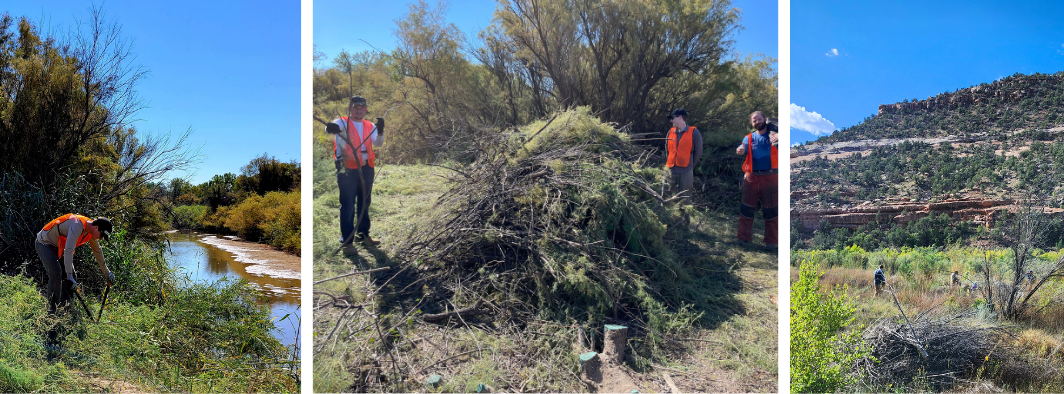
Volunteers will support riverbank restoration efforts along the Dolores River through the Dolores River Restoration Partnership (DRRP). Activities will include removing invasive woody plants and herbaceous weeds, as well as assisting with a range of seeding and planting techniques to optimize site-specific re-vegetation best practices.
During the project, sawyers will cut larger tamarisk stands, while other volunteers will use loppers to remove resprouts or drag and pile woody debris for burn or habitat piles. Once the area is cleared, trained and certified staff will apply herbicide to stumps to prevent regrowth. Volunteers will also help prepare sites for re-vegetation by removing weeds, raking debris, and prepping soil. If time allows, they may also participate in the seeding and planting of native plants.
Enjoy breakfast and lunch on Saturday and Sunday, with dinner on Saturday. Bring your own dinner on Friday night, and enough snacks for the weekend.
Free campsites are available on Friday and Saturday nights, and volunteers are encouraged to arrive at base camp before 8 pm on Friday.
Support This Project as a Crew Chef Helper!
We provide full meals on our overnight projects to ensure volunteers are well-fed and ready for a day of volunteering — and we could use your help to make it happen!
View this document to learn more about how to support and sign up.
Why It Matters:
The Dolores River is a 241-mile-long tributary of the Colorado River that passes through several special designation areas, including Wilderness Study Areas and Special Recreation Management Areas. The river supports agriculture, wildlife, and recreation, including whitewater rafting, fishing, and hiking, and is home to native fish species such as the roundtail chub, bluehead sucker, and flannelmouth sucker.
Despite its ecological and recreational value, the Dolores River faces significant challenges. Drought, overuse, and flow regulation from McPhee Dam have led to chronically low and highly variable flows. Invasive plants, particularly tamarisk, have further degraded the river corridor by displacing native vegetation, reducing biodiversity, increasing wildfire risk, and altering natural river dynamics. Dense tamarisk stands have impaired fish and wildlife habitat, impacted wetlands, obstructed recreational access, and disrupted natural processes by armoring riverbanks, narrowing the channel, and disconnecting the floodplain.
Efforts to remove tamarisk and restore native vegetation are critical to improving the health of this ecosystem. This work enhances both aquatic and terrestrial habitats, supporting biodiversity and benefiting the many communities and ecosystems that rely on the Dolores River. This project will be completed in partnership with RiversEdge West.
Eligibility Requirements:
Ages 18+
On this project, we need a mix of A and B certified Chainsaw Sawyers as well as volunteers that are not chainsaw certified. If you are certified, please include this in the Comments of your registration and send your certificate to the project manager. ALL SAWYERS MUST HOLD A CURRENT FIRST AID AND CPR CERTIFICATION IN ORDER TO OPERATE A SAW. Want to get certified? Visit our Training Calendar for upcoming training opportunities.
Project Difficulty:
This project is considered moderate; please check our difficulty rating criteria here for more details.
General physical considerations for participating on this project (some or all may apply): pulling or cutting vegetation; working on uneven, sloped, or rough terrain; bending and stooping for long periods; carrying and hauling vegetation; possible increased exposure to allergens; working near pesticides (managed by licensed people); potential for long hike; repetitive hand motions; and working around noise and vibration (chainsaws).
Access Factors:
Vehicle Access: Parking may be limited, so carpooling will be encouraged. The worksite is located within a short walk from the parking area.
Other Notes: Cell service is nonexistent or very limited.
If you enjoy chainsaw projects, either as a certified sawyer or a support volunteer, you can view similar projects here.

